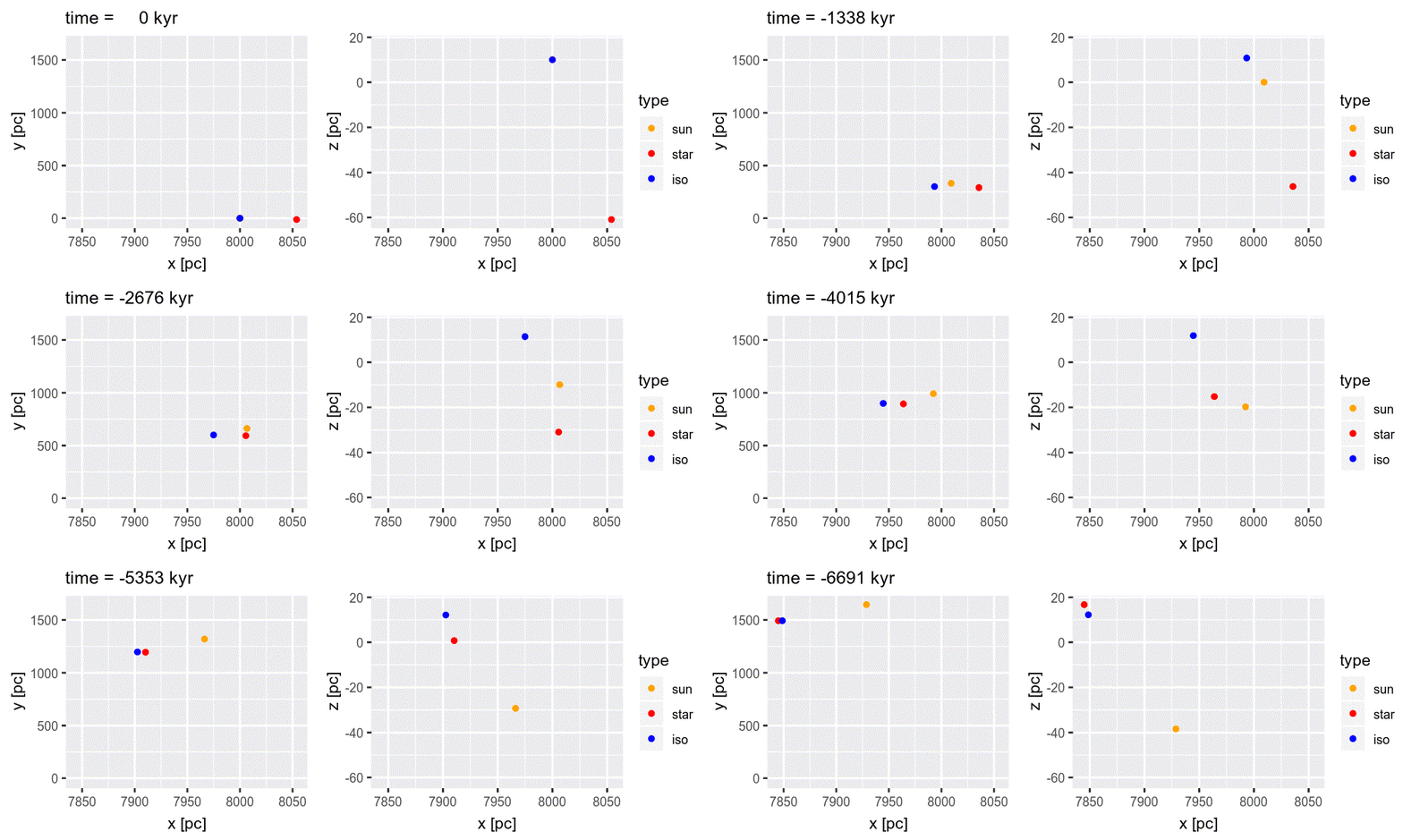
The first detected interstellar object 'Oumuamua that passed within 0.25au of the Sun on 2017 September 9 was presumably ejected from a stellar system. We use its newly determined non-Keplerian trajectory together with the reconstructed Galactic orbits of 7 million stars from Gaia DR2 to identify past close encounters. Such an "encounter" could reveal the home system from which 'Oumuamua was ejected. The closest encounter, at 0.60pc (0.53-0.67pc, 90% confidence interval), was with the M2.5 dwarf HIP 3757 at a relative velocity of 24.7km/s, 1Myr ago. A more distant encounter (1.6pc) but with a lower encounter (ejection) velocity of 10.7km/s was with the G5 dwarf HD 292249, 3.8Myr ago. Two more stars have encounter distances and velocities intermediate to these. The encounter parameters are similar across six different non-gravitational trajectories for 'Oumuamua. Ejection of 'Oumuamua by scattering from a giant planet in one of the systems is plausible, but requires a rather unlikely configuration to achieve the high velocities found. A binary star system is more likely to produce the observed velocities. None of the four home candidates have published exoplanets or are known to be binaries. Given that the 7 million stars in Gaia DR2 with 6D phase space information is just a small fraction of all stars for which we can eventually reconstruct orbits, it is a priori unlikely that our current search would find 'Oumuamua's home star system. As 'Oumuamua is expected to pass within 1pc of about 20 stars and brown dwarfs every Myr, the plausibility of a home system depends also on an appropriate (low) encounter velocity.
|
|
| The animation above traces the orbit of home-3 ("star") and 'Oumuamua ("iso") back in time to their mutual encounter. The coordinate system is Cartesian with the Galactic centre at (0,0,0) and is inertial with respect to that. Left is the view from the north Galactic pole (the z-axis is perpendicular to the Galactic plane); right is the view from l=90 (the direction of Galactic rotation). |
|
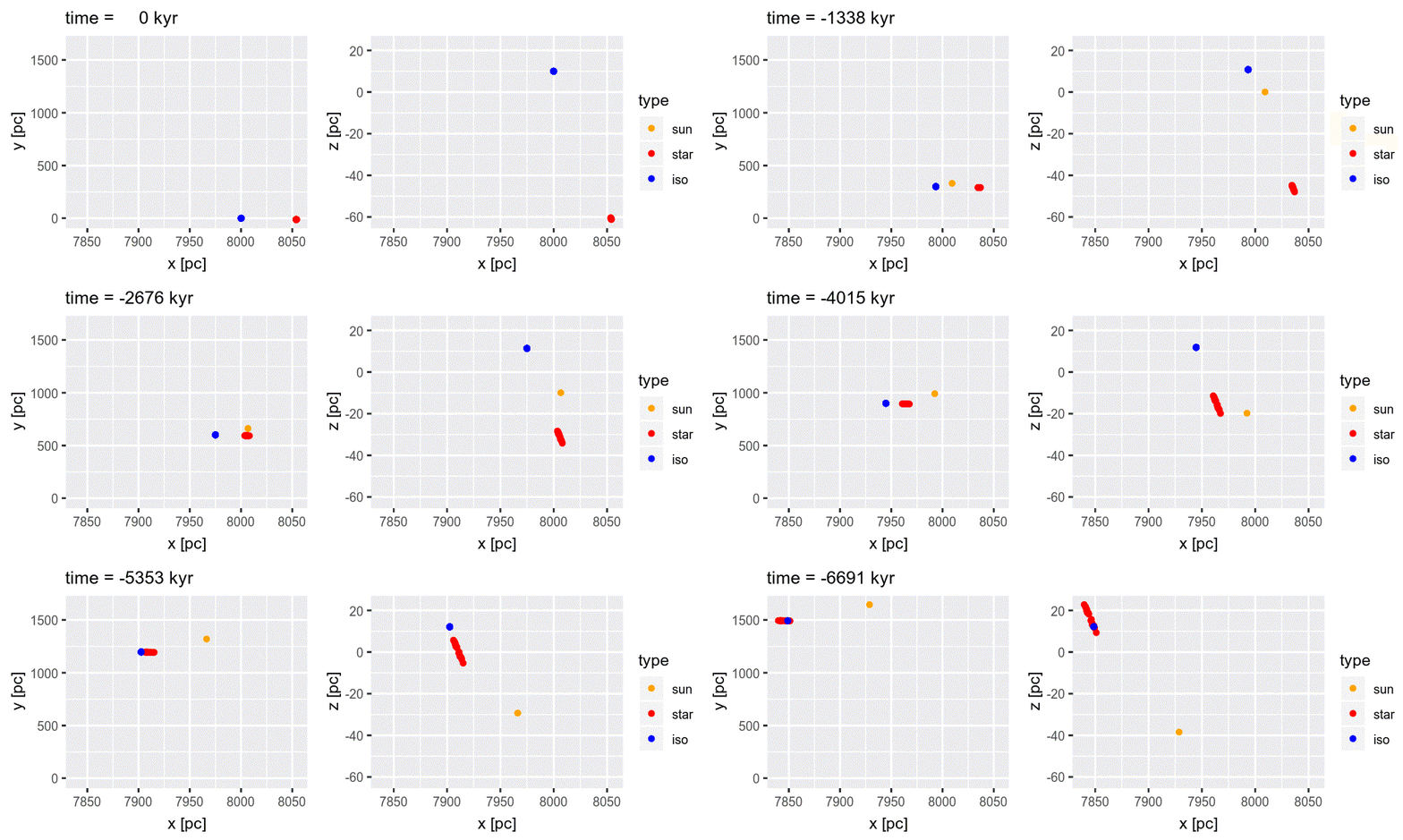
| As the previous animation, but now showing the effect of observational uncertainties on the back-tracking of the orbits. As explained in the paper, the star and 'Oumuamua are each replaced with a set of "surrogates" (just 20 shown here) obtained by sampling the uncertainties in their position and velocity measurements. The uncertainties in 'Oumuamua are so small on this scale that they are barely visible. |
The first interstellar object to pass through our solar system was detected by the Pan-STARRS survey on 19 October 2017 (Meech et al. 2017). Having already passed the Sun at a distance of 0.25au five weeks earlier, and moving out of the solar system at nearly 90 km/s, there was a frenzy of observational activity to characterize it before it was too faint to observe (which was the case by January 2018). It turned out to be a small elongated reddish object, possibly cigar-shaped with a length of 800m and width of around 80m, and tumbling around none of its axes of symmetry.
Based on its inferred hyperbolic orbit (i.e. it is unbound to the Sun), various groups traced it motion back in time through the Galaxy to see if they could associate it with a particular star. The movements of these stars over time must of course also be accommodated in such an analysis, and this was done using astrometry - parallaxes and proper motions - for stars from the TGAS component of Gaia DR1. Combined with radial velocities from other surveys, this provided a list of up to 300 000 stars which could be examined. Unfortunately, none of these studies found any convincing close encounters.
Now, the publication of Gaia-DR2 has allowed astronomers to look again into the question of 'Oumuamua's origin. This data release provides much more precise astrometry than DR1, and crucially includes radial velocities for over 7 million stars, thereby increasing the number of stars which can be examined by a factor of 20 over the TGAS-based studies. Furthermore, a team of astronomers led by Marco Micheli at the ESA SSA-NEO Coordination Centre has, in the mean time, used ground-based and HST observations to model 'Oumuamua's orbit more precisely (finding also evidence for a non-gravitational force, which is not uncommon among comets and asteroids; Micheli et al. 2018).
The new origins study, led by Coryn Bailer-Jones at Max Planck Institute for Astronomy in Heidelberg, has identified four plausible home stars for 'Oumuamua. Assuming that 'Oumuamua was ejected from a stellar system, either through interactions with a giant planet or a second star in that system, then a plausible origin is revealed via a close and slow encounter in the past (which would then indicate the time and speed of ejection). Although none of the encounters are very slow (the slowest is of order 10 km/s), the residual uncertainties in the analysis mean that these are good candidates, and the best found so far. None of the stars has published planets or is known to be a binary, but further investigation will be required to confirm or refute this.
There are of course a number of caveats of this study. All of the home candidate stars are low mass (of order a solar mass or less), relatively nearby, and encountered 'Oumuamua within the past 7 Myr. These are to some extent selection effects of the study, because to have a measurable radial velocity in Gaia-DR2 the star must be relatively bright. Indeed, given that there are of order 10^11 stars in the Galaxy, and we have no good indications of 'Oumuamua's age, then it is not unlikely that it was ejected from one of the many stars which could not be studied using Gaia-DR2. On the other hand, if 'Oumuamua turns out to have been ejected within the past few million years, then there is a reasonable chance this study has identified its home system. Further investigation will have to await the publication of Gaia-DR3, planned for 2021, which should provide radial velocities for many more stars.